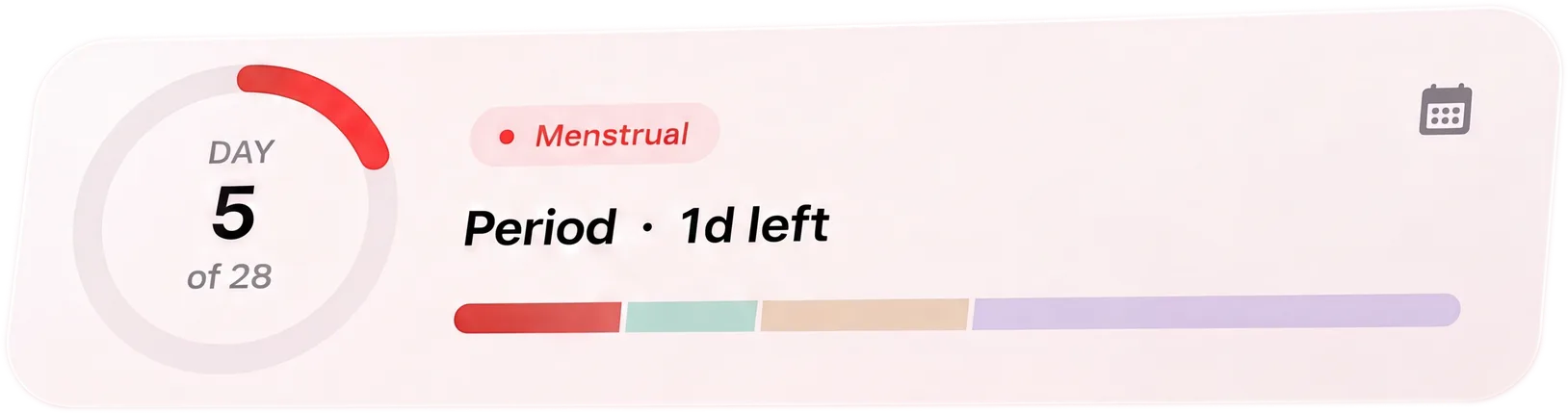
What BaeMax shows
BaeMax presents the next period as a range and labels confidence so a user can tell whether the estimate is still shaky.
- Date range, not only one day
- Early, getting clearer, or good confidence
- Explanation of history and variability
- Logged days visually separate from projected days
Why confidence changes
A tracker has less to work with when history is short, cycles vary a lot, or context recently changed.
- More logged cycles can improve confidence
- Irregular cycles reduce certainty
- HRT, postpartum, loss, and other contexts can make timing variable
- Recent changes should make estimates more cautious
What to do with low confidence
Low confidence is a planning cue, not a failure. Treat the range loosely and avoid decisions that need certainty.
- Plan period supplies with a wider window
- Use contraception, not the estimate
- Log more cycles before trusting the pattern
- Bring the uncertainty to appointments if timing matters
What not to use it for
Confidence labels make predictions clearer. They do not make predictions medical certainty.
- Not contraception
- Not diagnosis
- Not a guarantee of ovulation or bleeding
- Use medical care for concerning symptoms
Interpret confidence as evidence quality
A confidence label should reflect how much consistent history supports the estimate, not how strongly the app wants you to believe it. Ask what data window is used, whether manually corrected dates replace old mistakes, and whether recent variability lowers confidence. A good interface should keep the range visible and explain why it widened or narrowed. It should not quietly turn a low-confidence range into one highlighted day on reminders or partner screens.
- Check whether the range changes after correcting an incorrect period start.
- Expect early history and irregular cycles to produce wider uncertainty.
- Treat missed or late bleeding as new information, not proof of pregnancy or illness.
- Use appropriate testing and clinical advice when a real decision requires more certainty.
- A partner who sees the range should receive the same confidence context, not a simplified countdown that looks certain.
- Review confidence after postpartum changes, pregnancy loss, starting or stopping hormones, or a long gap in logging rather than assuming older history still dominates.
- When confidence stays low, the useful output is the dated history and wider planning window, not repeated attempts to force a precise forecast.
- Check whether skipped logs reduce confidence transparently instead of being silently treated as symptom-free or period-free days.
- Keep travel plans, supplies, and appointments flexible across the full range rather than anchoring on its midpoint.