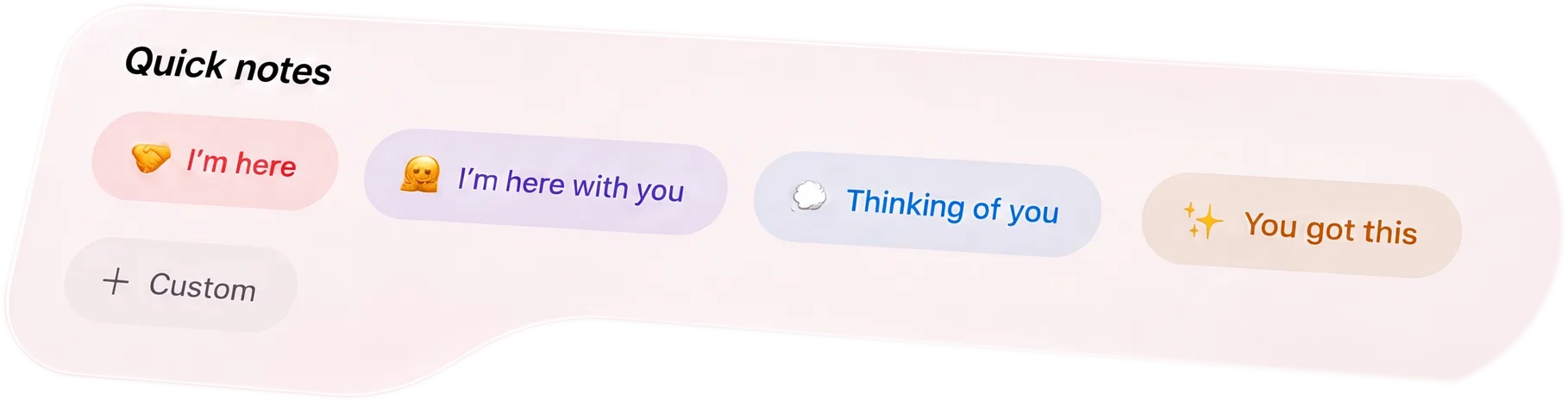
What BaeMax can communicate
BaeMax documents custom quick notes between a consented pair. The sender can write a direct no-touch message, but the current public pages do not promise a structured field, a default sharing state for that field, or automatically filtered advice.
- User-authored custom quick note
- Chosen delivery to the paired person
- Custom quick note in your own words
- No inferred consent or mood
What the partner should do
The right response to no-touch is not to negotiate a different kind of touch. Switch to non-touch support or leave space.
- Ask later, not again in the moment
- Skip bargaining for a hug, kiss, or cuddle
- Offer water, food, a task, quiet company, or space only if invited
- Check in later with words, not touch
What an app cannot enforce
BaeMax can communicate a preference. It cannot monitor consent, prevent harm, or force someone to respect a boundary.
- Not a consent enforcement system
- Not safety monitoring
- Not a replacement for leaving unsafe situations
- Not a tool for arguing about the boundary
How to make it clearer
Use plain wording. The goal is not a poetic message. The goal is to remove ambiguity at the exact moment ambiguity causes problems.
- No hugs today
- Please do not touch me right now
- I want company without touch
- Ask first before physical comfort
Separate a standing agreement from the current note
BaeMax does not publicly document a persistent no-touch profile field, so make any standing agreement in conversation and use a quick note for the current moment. Agree on a simple acknowledgement and one non-touch fallback such as leaving supplies nearby, handling a task, or giving space. Test the note after pairing and after a notification change. A delayed or missed note is not consent to touch, and silence should not be treated as a changed boundary. If a partner argues with or repeatedly ignores the request, adding more app settings will not fix the problem; stop sharing and use a trusted person or appropriate safety resource instead.
- Current words override any saved preference
- Choose one acknowledgement and one non-touch fallback
- Treat missing notifications as missing information, not consent
- Stop the setup when the boundary is not respected
Use words that cover the exact boundary
No touch can mean no comforting touch, no sexual touch, no contact with a painful area, or no physical contact at all. The sender should not have to explain why, but specificity can prevent accidental overreach when they have the energy to provide it. A current direct statement always outranks an earlier app preference. The receiver's job is to acknowledge and stop, not to decide whether the reason is sufficient.
- Use 'no physical contact right now' when the boundary is broad.
- Use 'please ask before any touch today' when consent needs to be requested each time.
- Affection earlier in the day is not continuing consent.
- Offer non-touch support once, then accept no.