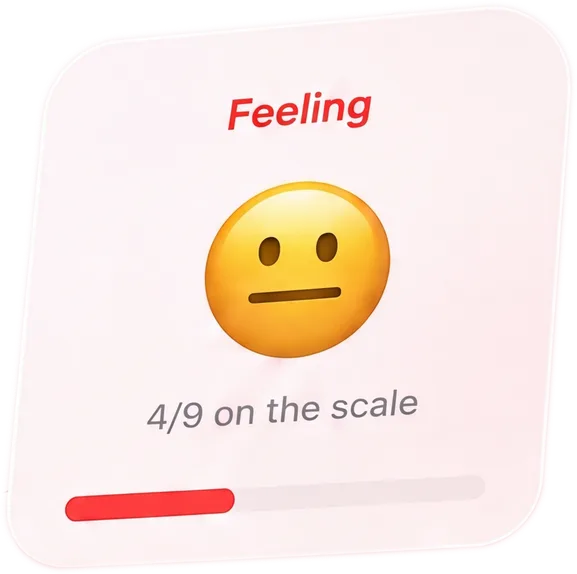
What the signal can say
Your partner sees how the day's going instead of trying to read it off your texts.
- I am having a bad day
- I do not have much energy
- I may not reply much
- Support is welcome, but keep it simple
What it should not demand
A check-in should not force a full emotional report or make the sender reassure the receiver.
- No essay required
- No instant conversation required
- No relationship score
- No pressure to explain before ready
What your partner should do with it
A bad-day signal works best when the response is already simple: acknowledge it, offer one useful action, or give space. The signal should not start an interrogation.
- Acknowledge: 'I saw it. I'm here.'
- Offer one action: dinner, an errand, water, or quiet.
- Give space if that is what the check-in asks for.
How BaeMax fits
BaeMax turns the first signal into a small shared point, not a crisis system.
- Quick feeling check-in
- Optional note
- One paired partner
- Not therapy or emergency support
Write the response before the bad day
A signal becomes useful when both people already know what may follow. On a calm day, agree on two or three responses that are easy to accept or decline. One person might want a quiet message, help with dinner, company without questions, or uninterrupted space until a stated time. Avoid a long preference menu that creates more decisions when energy is low.
- Use one plain status and an optional sentence of context
- Say whether you want listening, practical help, company, or space
- Name a time for follow-up only when you want one
- Let the receiver say what help they can realistically offer
Use direct words when the issue has consequences
A bad-day check-in should not carry a breakup decision, a work cancellation, a medical emergency, or a request that must be answered by a deadline. Put the actual request in a direct message or call and confirm it was received. A mood signal is context, not proof that the other person understood a plan.
If the pattern keeps repeating
Review what happens after the signal. If your partner repeatedly pushes for details after you ask for space, the problem is not the check-in format; the boundary needs a conversation. If both people want to help but the available responses miss the mark, rewrite them. If bad days are frequent, worsening, or affecting everyday functioning, consider qualified support. The app can make it easier to say that today is difficult, but it cannot explain why or provide treatment.