PMDD mode

Track PMDD patterns by cycle phase, not just 'felt bad this week'

A period tracker for PMDD should show when mood impact repeats across the cycle. BaeMax's PMDD-focused mode keeps that timing beside the rest of your private log.

By BaeMax LovePublished Reviewed How we compare
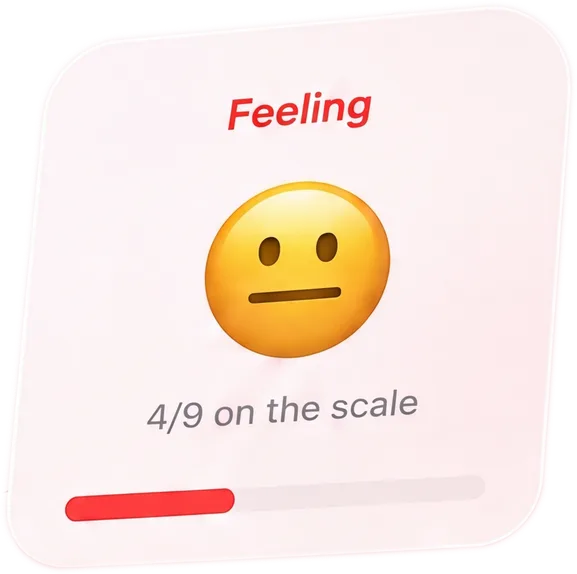
BaeMax Feeling card showing 4 out of 9 on the scale
Mood pattern boundary

PMDD tracking should connect timing and impact without becoming crisis care

A PMDD-oriented tracker is useful when it shows whether severe mood symptoms repeat in a cycle-linked pattern. It must not promise diagnosis, treatment, or crisis support.

The pattern matters more than one bad day

PMDD concerns usually require seeing timing over more than a single week. The record links mood, irritability, anxiety, sleep, energy, conflict, work impact, and cycle timing so the person can discuss repeated patterns with qualified care.

  • Track symptoms by date.
  • Mark how symptoms affected daily life.
  • Look for repeated timing, not isolated proof.

Crisis moments need real support

If someone is having thoughts of self-harm, panic that feels unsafe, or a mental-health crisis, an app log is not the support plan. Use local emergency or crisis resources right away.

  • You shouldn't wait for an app if there is danger.
  • Use qualified mental-health support.
  • Tell a trusted person if immediate help is needed.

Partner sharing needs care

A partner can help by understanding that mood symptoms may be time-linked and intense. They should not use the tracker to dismiss feelings as hormones or monitor someone without consent. Many people will do better sharing a summary or support preference than every mood entry.

  • Share a summary if raw mood entries would create pressure.
  • Share support preferences, such as space, fewer decisions, or a check-in later.
  • Ask for specific support, not interpretation.
  • You shouldn't let a partner label the person’s mood for them.

How to use the log well

Use the tracker to prepare a calm summary: when symptoms start, when they ease, what severity looks like, what helps, and what questions to ask a clinician.

  1. Track at least dates and impact.
  2. Note sleep and major stressors.
  3. Bring the pattern to qualified care.

Use prospective daily ratings instead of reconstructing the month

PMDD assessment depends on the relationship between symptoms and the menstrual cycle, so memory at the end of a difficult month is not enough. The Office on Women's Health says a symptom calendar or diary helps a doctor diagnose PMDD. Log at roughly the same time each day, including days when symptoms are absent. Track a small stable set such as depressed mood, anxiety, irritability, concentration, sleep, energy, physical symptoms, and functional impact. The symptom-free or lower-symptom interval matters as much as the difficult days because it helps show whether symptoms follow the cycle or persist throughout the month.

  • Continue for at least two cycles if a clinician asks for prospective ratings; do not fill missing days from memory as though they were observed.
  • Record treatment changes and major stressors without assuming either one explains the whole pattern.
  • Use neutral descriptions of conflict or impairment instead of assigning blame to yourself or a partner.
  • Take the completed daily record to a clinician who can consider PMDD alongside depression, anxiety, medication effects, and other possible causes.
  • Choose ratings you can repeat even on difficult days; a short complete daily set is more useful than a detailed form abandoned during the symptomatic week.
  • If symptoms include suicidal thoughts or immediate danger, stop tracking and contact local emergency or crisis support now. A predicted phase is never a safety assessment.
  • Ask the clinician how to continue tracking after treatment begins so changes can be compared without treating the app score as the treatment decision.
  • Record the first day of bleeding consistently so the symptom timeline can be aligned with the same cycle marker each month.
Key facts
Made for
People tracking mood impact beside cycle phase
Data model
Stays on your phone. Mood details stay private unless you share them.
Best for
A dated mood-impact pattern and doctor-ready report
Not for
Diagnosis, treatment, crisis support, or emergency monitoring
Why people switch
  • Symptoms blur together. Without a dated log, it is easy to forget when mood changes happened and how much they affected work, school, relationships, or safety.
  • Timing is context, not a diagnosis. Tracking mood against cycle phase can show a repeated pattern. It cannot tell you why the pattern exists or diagnose PMDD.
Side by side

BaeMax vs Me v PMDD and mood journals

Mood tracked against cycle phase specifically
BaeMax: Yes. Mood impact can sit beside cycle timing.
Me v PMDD and mood journals: Mood journals often track mood well but do not tie it to cycle phase without manual tagging
PMDD-specific focused mode
BaeMax: Yes. The profile emphasizes mood impact and cycle timing.
Me v PMDD and mood journals: Dedicated PMDD tools may go deeper for that one need
Doctor-ready report
BaeMax: Yes. It can summarize dated mood, sleep, pain, cycle timing, and impact.
Me v PMDD and mood journals: Varies by app; check what the report includes
Data stays on device by default
BaeMax: Yes. Mood details stay private unless you share them.
Me v PMDD and mood journals: Most cloud-based trackers are not

App features, policies, and prices can change. Check each product's official information before deciding.

Common questions

is there a tracker that links mood to cycle phase instead of just a generic mood log?
Yes, BaeMax's PMDD-focused mode is built to emphasize mood impact alongside cycle phase, so the pattern across a month is visible instead of scattered notes. It's still self-report, not a clinical assessment.
can this diagnose pmdd?
BaeMax can help you keep a dated symptom log, but it does not diagnose PMDD or interpret the log as proof. Bring concerns and the report to a qualified clinician.
is me v pmdd better since it's specifically for pmdd?
A dedicated PMDD tool may suit someone who wants only that one job. BaeMax provides a broader cycle log with a PMDD-focused profile, without diagnosing PMDD or replacing care.
if i'm having dark thoughts before my period is this app going to help with that in the moment
Use professional help for that. Contact a mental health professional or a crisis line in your area, and use local emergency services if there is immediate danger. BaeMax is a tracking tool, not crisis support or treatment.
does my partner see my mood logs if i don't want them to
Mood and symptom detail stay private unless you specifically choose to share that category, and sensitive categories are off by default.

Sources

  1. Office on Women's Health: PMDD
  2. BaeMax product factsCurrent mood tracking, doctor-ready report, support preferences, and platform status
  3. BaeMax privacy architectureCurrent private-record and selected-sharing model

Turn the signal into something useful

Use BaeMax when a partner needs a clearer check-in, a short note, or one practical task instead of another long conversation.

Android private beta. The iPhone version is in development.