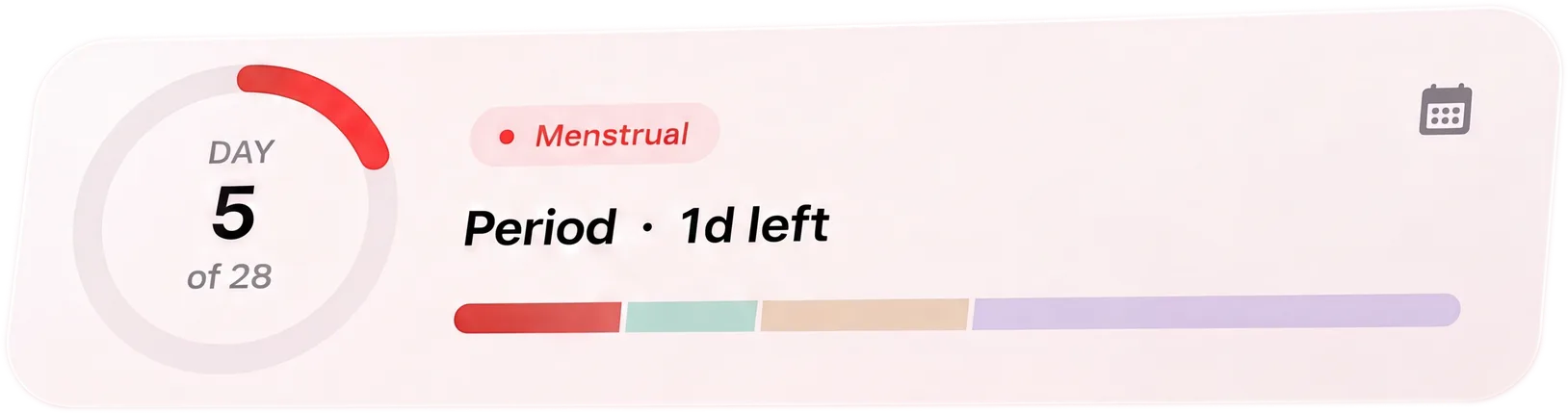
Confidence should drop when cycles change
Perimenopause tracking should not pretend the app can keep a tight prediction window when the body is changing. Wider ranges and lower confidence are clearer than a clean calendar that keeps being wrong. Balance may fit better if you want menopause education. BaeMax fits the narrower job of a private cycle record with optional partner support.
- Log cycle gaps and skipped periods.
- Track sleep, hot flashes, mood, and bleeding changes.
- Treat estimates as rough planning only.
What BaeMax can and cannot cover
BaeMax can help track bleeding changes, cycle gaps, hot flashes, sleep disruption, mood, energy and appointment notes. It is not a menopause coaching program, hormone test, medication guide or treatment plan. Use a dedicated menopause tool or clinician when education, treatment options or stage guidance are the main need.
An app can't assign a perimenopause stage
Perimenopause is a health transition, but an app should not label a stage or decide what treatment someone needs. Logs can make a clinical conversation easier; they do not replace it.
- Bring dated changes to appointments.
- Ask about symptoms that disrupt life.
- You shouldn't rely on an app for medical decisions.
Partner support can be practical
A partner does not need to analyze hormone changes to help. They can understand poor sleep, low energy, heat sensitivity, mood changes, or the need to adjust plans. The shared signal should be practical and chosen by the person tracking.
- Share the support need, not every detail.
- Use tasks and notes for concrete help.
- Keep sensitive symptoms private unless sharing helps.
What a useful summary contains
The best summary is boring and specific: cycle dates, bleeding changes, sleep disruption, hot flashes, mood shifts, and what changed work, family, or relationship life.
- Record what happened and when.
- Mark severity and disruption.
- Bring questions to qualified care.
Track bleeding changes with enough detail to act on them
A calendar mark for period or no period can hide the change that matters. Record flow in a consistent way, the number of bleeding days, spotting between periods, clots if relevant, and whether bleeding interrupts sleep or normal activity. Also note symptoms that may need separate attention, such as dizziness, shortness of breath, new pelvic pain, or bleeding after sex. Perimenopause can change cycle timing and flow, but it should not be used as a blanket explanation for every new symptom. A clinician can decide whether examination or testing is warranted.
- Use the same light, medium, or heavy definitions from month to month.
- Record the date of any hormone therapy, contraception, supplement, or medication change rather than attributing the next cycle to it yourself.
- Ask promptly about very heavy bleeding, bleeding that causes weakness or dizziness, bleeding after menopause, or any pattern that worries you.
- Keep sleep and hot-flash notes separate from bleeding fields so each pattern remains readable.
- Record vaginal dryness, urinary symptoms, headaches, or concentration changes only when they matter to the question you plan to discuss; the tracker does not need to become a catalogue of every sensation.
- A full year without a period changes the meaning of later bleeding. Report postmenopausal bleeding to a clinician rather than restarting an ordinary cycle forecast.
- If sleep is the main problem, note awakenings, heat episodes, and next-day impact so the appointment is not reduced to cycle length alone.
- Keep estimates out of contraception decisions because ovulation timing can be unpredictable during perimenopause.
- Bring the actual calendar to care rather than relying on the app's phase name.