Identify whether time or energy causes the missed connection
Two people can know exactly when dinner is and still not know that one partner has no energy to cook. They can also understand each other's moods perfectly and still double-book Saturday. The first problem needs a support signal; the second needs calendar coordination. Look at the last three plans that went wrong and classify the failure before choosing an app.
Choose Cupla for the scheduling layer
Cupla's official product pages describe shared calendar features, calendar syncing, reminders, date planning and shared to-dos. If your pain is scattered work calendars or repeated 'what are we doing tonight?' messages, that broader planning system is the relevant tool. BaeMax does not sync Google or Apple calendars.
Choose BaeMax for the partner support
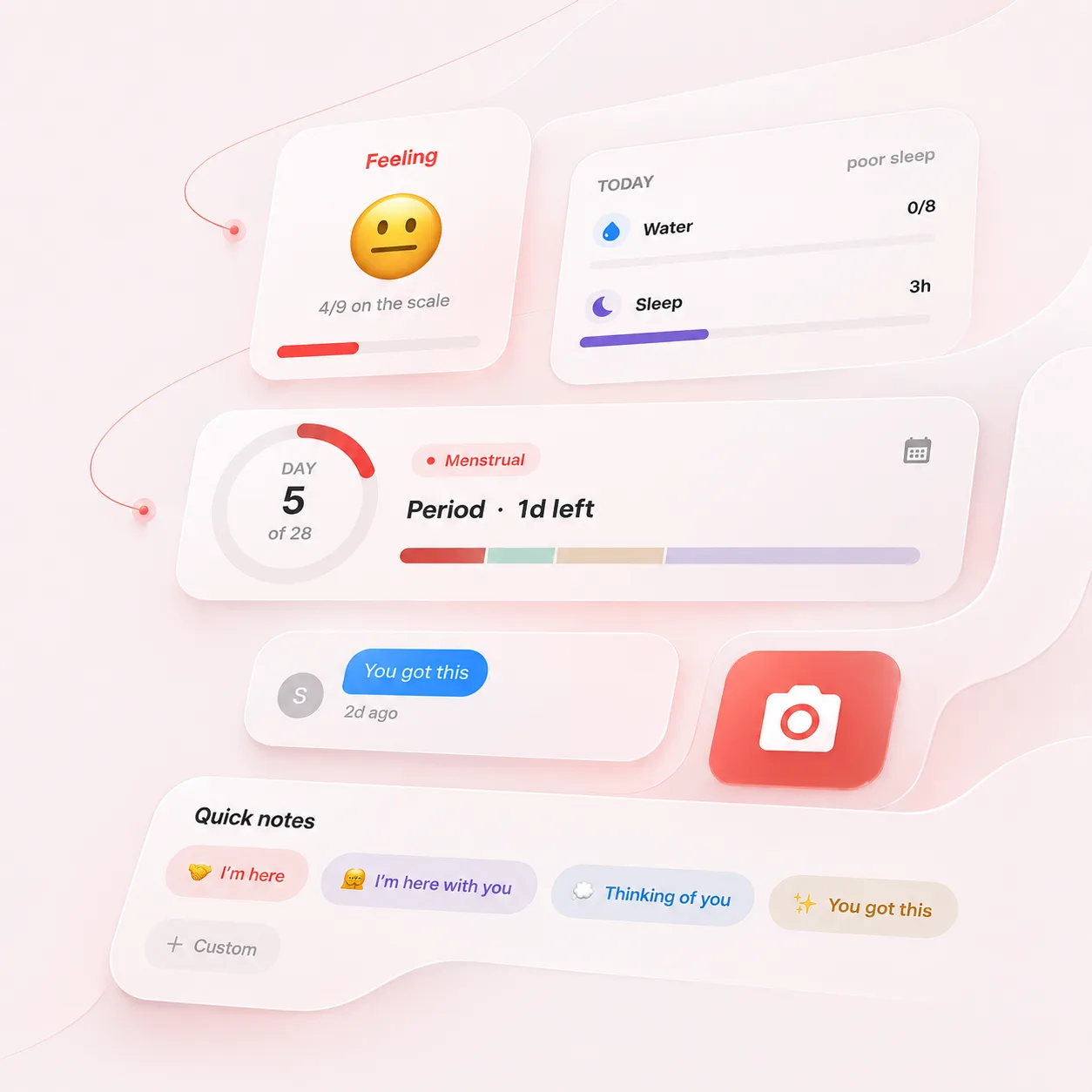
BaeMax is useful when a plan exists but one person's energy changes. A quick check-in can show a bad day; chosen cycle context can explain why support might help; a shared task can make the response concrete. The tracker decides what gets shared. A supporter sees context, not ownership of the other person's body or schedule.
The 7 p.m. plan-change test
Dinner is on the calendar for 7 p.m., but one person hits a wall at 6:30. Cupla can hold the plan. BaeMax can say, 'I am out of energy, can we switch to takeout and can you handle the dishes?' If that is the moment you keep missing, BaeMax has a real job.
Build a two-layer system without duplicate noise
Some couples need both categories. Give each tool a narrow responsibility.
- Put appointments and future plans in one calendar system
- Use BaeMax only for check-ins and near-term support tasks
- Turn off duplicate reminders in whichever app is secondary
- Agree which app is authoritative when details conflict
- Review after two weeks and remove any app habit neither person uses
Know BaeMax's practical limits
BaeMax task due dates use a short horizon and do not replace long-range planning. If device support or a synced calendar is non-negotiable, Cupla or another calendar product is the practical choice.
The choice
Choose Cupla when the relationship problem lives on the calendar. Choose BaeMax when it lives in the gap between 'I know our plan' and 'I know what support would land.' Switching for novelty won't fix a repeated problem. A focused app is valuable only when its need matches a repeated real-life problem.
Compare what each person has to do
Pick one situation that repeatedly goes wrong and trace it through each product. For a changed dinner plan, ask who notices the conflict, who updates it, and whether both people see the new time. For a low-energy evening, ask how one person signals capacity and how the other learns what would help. Cupla's official product is centered on a shared calendar, lists, reminders and date planning. BaeMax is centered on a small check-in, selected cycle context, support preferences and shared care tasks. A longer feature list does not make either option better if the other person still needs a second app or another explanation.
- Use a real missed appointment to test calendar ownership and reminders
- Use a real exhausted evening to test context and practical follow-through
- Count duplicate entry and notification noise across any two-app setup
- Keep the tool that prevents the repeated failure with less upkeep
Check the household boundary
A couple may eventually need family calendars, work schedules, school events, meal planning, or several collaborators. That broader logistics problem points away from BaeMax's one-pair design. Conversely, a busy calendar can show where someone is without showing whether they have energy for the plan. Decide whether the missing information is logistical, personal, or both. If it is both, keep times in one app and care preferences in the other so changes do not have to be reconciled in two places.