For the supporting partner

Know when she's having a rough period day without making her explain it again

If your girlfriend chooses to share her cycle in BaeMax, you get a quiet heads-up and a few specific, easy-to-decline ways to help, based on what she told you works, not on what an app guessed.

She chooses what to shareNo hidden trackingPractical support
By BaeMax LovePublished Reviewed How we compare
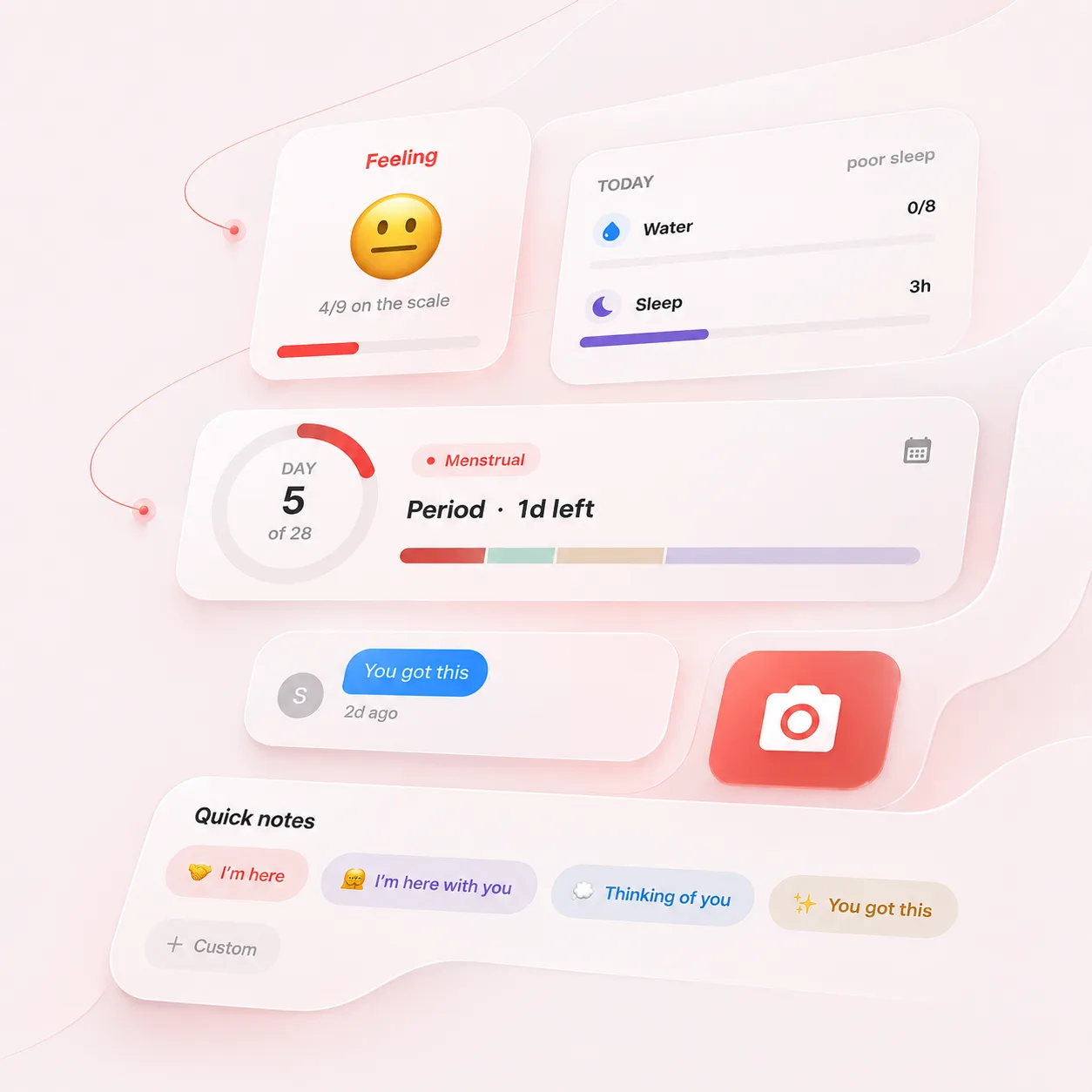
BaeMax interface showing a feeling check-in, water, sleep, cycle context, and quick care notes
Short answer

BaeMax has a partner view. If your partner shares selected cycle context, you can see a short daily summary and practical, easy-to-decline support suggestions. The app shows only what she chose to share, and suggestions use preferences she set, such as comfort, food and communication choices. She can change or stop sharing at any time.

Practical guide

Support starts with permission, not access

Useful support begins with permission, agreed preferences and small actions that are easy to accept or decline.

Good support is specific

The move is rarely 'tell me what to do' in the middle of cramps. The move is knowing the agreed basics before the hard day.

  • What food or drink helps
  • Whether company or quiet helps
  • Which words make things worse
  • Which task you can remove from the day

What BaeMax can show

If she chooses to share, BaeMax can give a supporter enough context to be useful without exposing every private symptom entry.

  • Cycle phase or rough timing
  • A next-day heads-up
  • Support preferences written by her
  • Practical suggestions that are easy to decline

What not to do

You shouldn't use cycle information as surveillance, a mood explanation for every feeling, or a reason to argue about whether symptoms are real.

  • It only works if she chooses to share, never as something you switch on for her
  • She decides how much detail you see; pushing for more defeats the point
  • Predictions are estimates, not certainty
  • Use medical care for severe or unusual symptoms

Make a plan while she feels well

A period-support app is most useful after a short conversation on an ordinary day. Ask which signs are worth sharing, what kind of help is welcome, and what should remain private. Write down two or three dependable options rather than building a long menu she has to manage while uncomfortable.

  1. Agree whether a shared phase, a next-day heads-up, or no cycle detail feels right
  2. Name one practical task you can take over without asking her to supervise it
  3. Separate comfort ideas from medical decisions
  4. Revisit the agreement if her symptoms, schedule, or comfort with sharing changes

Know when ordinary support is not enough

Painful periods are common, but severe pain should not be normalized just because it happens every month. ACOG advises seeking care when pain interferes with everyday activities or worsens over time. Heavy bleeding, fainting, fever, sudden severe pain, or symptoms that feel alarming deserve professional advice rather than an app suggestion. Offer to help with transport, appointment notes, meals, or other logistics if she asks. Do not diagnose the cause, choose treatment for her, or treat a prediction as proof of what is happening. The useful role for a partner is to believe what she reports, reduce avoidable work, and support the care decision she makes.

  • Ask whether she wants company, practical help, or privacy
  • Take a concerning change seriously even when the calendar predicts a period
  • Use urgent local medical services when symptoms may be an emergency
How it works

How supporting her works

  1. She tracks her own cycle in BaeMax, privately, on her phone.
  2. She decides what to share with you, category by category. She can share the phase and a heads-up while keeping detailed symptoms private.
  3. You get a short 'today' summary in the supporter view, plus a 'tomorrow' heads-up so a bad day does not catch you off guard.
  4. BaeMax suggests one small, practical thing, based on the preferences she set, like a food she likes or simply giving her space.
  5. You help, or you do not. Every suggestion is easy to skip. It is a nudge, not a chore list.
What it does
She decides

Only what she shares

Nothing is visible to you unless she turns it on. There is no silent monitoring and no way to track her without her knowing.

Specific

Her preferences, not clichés

She can set the foods she eats, the products she uses, whether she wants company or space, and words she does not want to hear.

Low pressure

Help that is easy to decline

Suggestions are small and practical. Reduce a decision, keep water nearby, take a shared task off her plate, or just be around.

What you can do in the app

  • See her cycle phase and a next-day heads-up, if she shares it
  • Get one practical support idea a day that respects her stated boundaries
  • Send a quick note like 'thinking of you' or 'I'm here' without needing a reply
  • Pick up a shared task so she has one less thing to hold
  • Back off cleanly when the signal is 'I want space'
Key facts
Tracker stays in charge
She chooses whether to pair and which cycle categories to share
Supporter view
Selected context plus practical suggestions that can be declined
Best first question
What would help today, if anything?
Prediction format
A date range with a confidence level, not an exact promise
Privacy
Unshared cycle details remain on her phone
Medical limit
Not diagnosis, treatment, contraception or emergency monitoring

Common questions

my gf gets bad cramps, is there an app that tells me when so I can help?
Yes, if she shares her cycle with you in BaeMax, you get a phase view and a next-day heads-up. The point is to help you prepare without interrogating her. She controls how much detail you see.
is this basically tracking my girlfriend? that feels weird
It is the opposite. She tracks herself and chooses what to share. You cannot see anything she has not turned on, and there is no hidden monitoring. If that consent is missing, the app is not for you.
what if I help wrong and make it worse?
That is why the suggestions come from her own settings, like the foods she likes and whether she wants space. It is built to give your partner clearer context, not replace paying attention to her.
does she have to share her actual symptoms?
She can share just the phase and a heads-up and keep pain details, intimacy, and notes completely private. Sensitive categories are off by default.
can either person stop sharing later?
Yes. The tracker controls sharing categories and can change or revoke them. Unpairing also revokes future partner access.

Know how to help today

If she chooses to share cycle context, BaeMax turns her preferences into small, respectful support options.

Android private beta. The iPhone version is in development.